
























It's Monday, 9:10. You're the only marketer at Tallybook, a small invoicing app, and you have 20 tabs open across three rivals. On Thursday a prospect on a sales call asks how your pricing compares to Billwise's new free tier. Nobody at Tallybook knew Billwise had one.
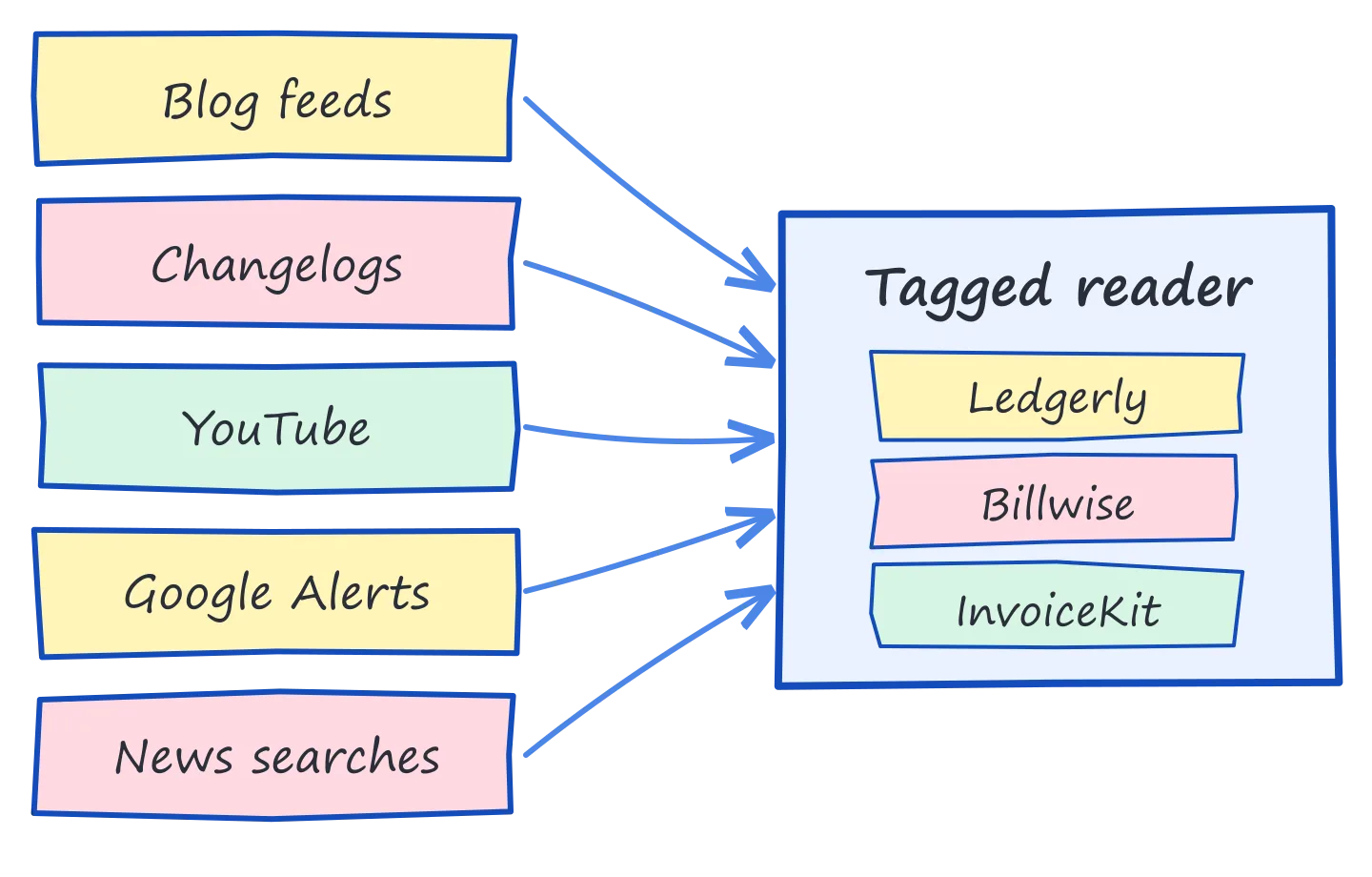
Tallybook and its rivals are made up for this post. The fix is real: run competitor monitoring through feeds instead of tabs. Blogs, changelogs, press mentions and YouTube channels can each be turned into a feed. Put those feeds in one reader, tag each one by rival, and read them once a week.
Why the 20-tab check keeps failing
Say Tallybook's three rivals are Ledgerly, Billwise and InvoiceKit. Each has a blog, a changelog, a pricing page and a YouTube channel. InvoiceKit also keeps an open-source API client on GitHub. Add a news search per rival and you're past 15 places to check, every week, by hand.
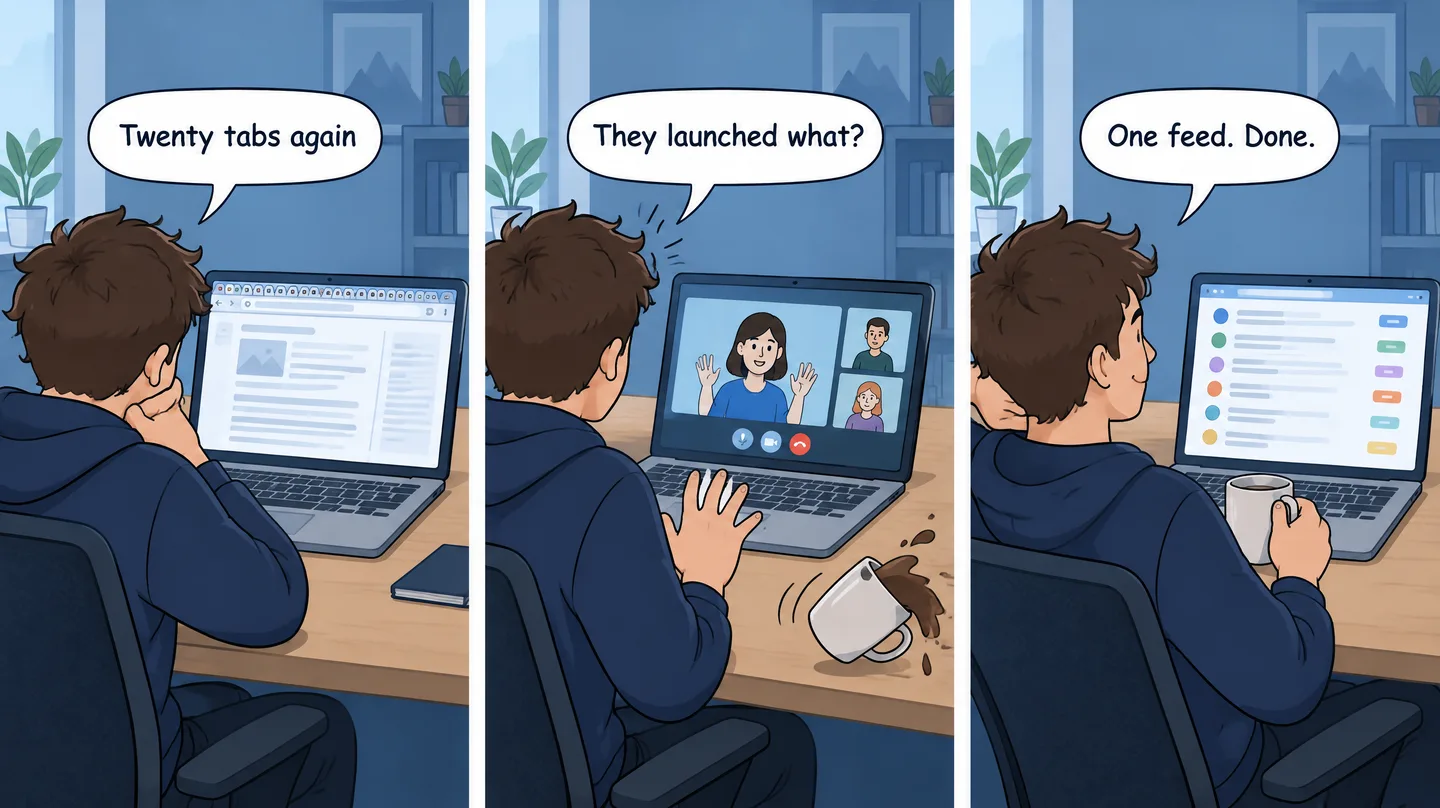
Checking by hand fails in two ways. Some weeks you skip it, because a launch or a webinar ate the morning. Other weeks you open everything and still miss the change that mattered, because it sat on a page you didn't think to open.
Billwise's free tier is that kind of change. It might show up as a changelog line, a new pricing page, a launch post and a small mention in a newsletter, all in the same week. A tab habit catches one of those if you're lucky.
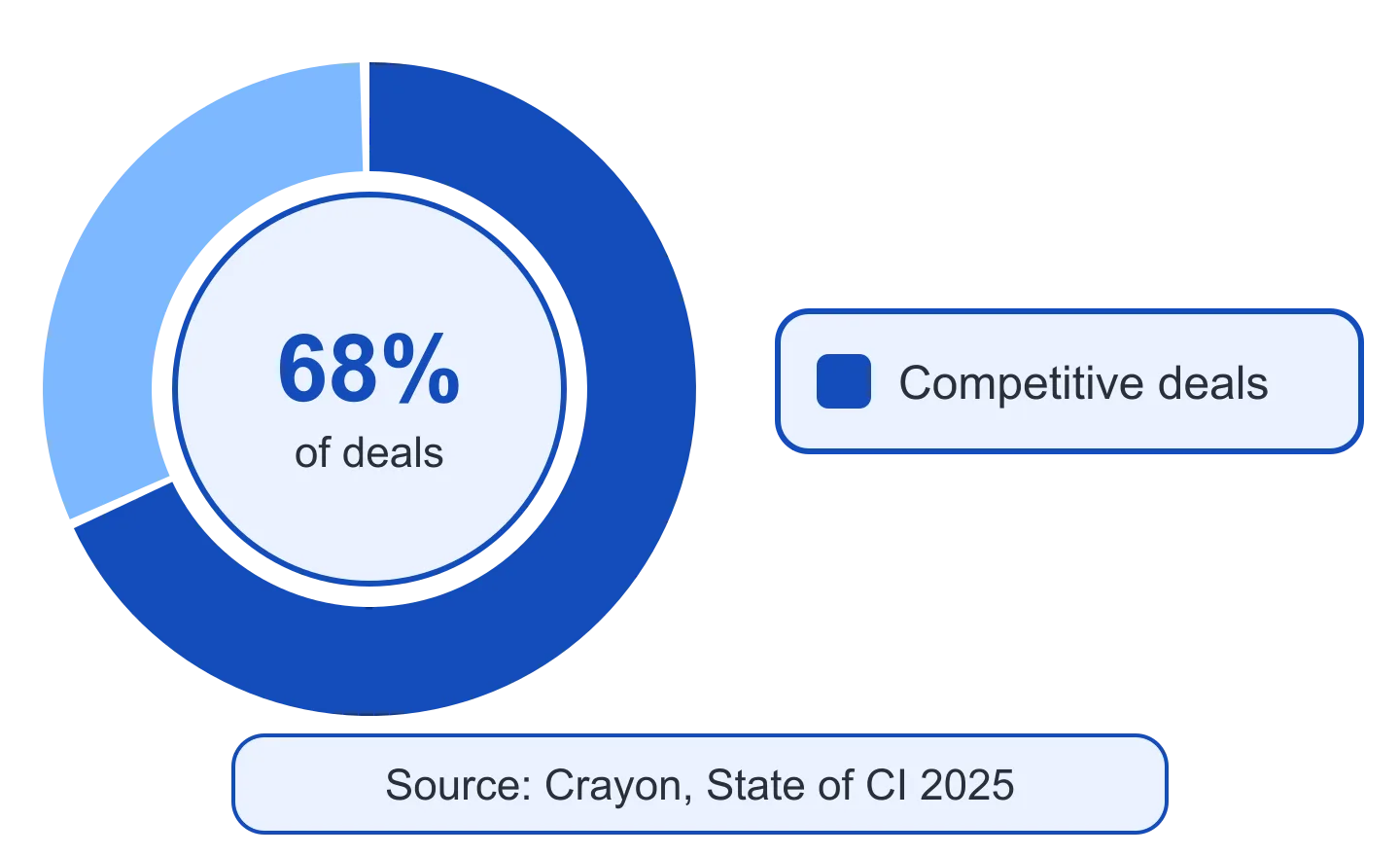
And the miss shows up in sales. Crayon's 2025 State of Competitive Intelligence report found that 68% of deals are competitive. The same report says the average team rates itself 3.8 out of 10 at competitive selling. When more than two in three deals have a rival in them, your sales team needs to hear about a free tier before the prospect does.
The five places competitors publish, and the feed for each
Go through one rival at a time and fill in a feed URL for each of these.
Blog and articles
Try the common paths first: /feed, /rss and /blog/feed.xml. A feed can exist even when no page links to it. WordPress sites, for one, generate RSS 2.0 and Atom feeds by default.
So if Ledgerly's blog runs on WordPress, ledgerly.com/feed has a good chance of working even though the site never shows an RSS icon. If none of the paths work, our guide on how to find an RSS feed URL covers the other places to look.
Some founders write on Medium or Substack instead of the company blog. Those profiles can be turned into feeds too.
Changelog and releases
The changelog is one place Billwise's free tier could show up, often as one dry line. Changelogs can be turned into feeds, even when the page doesn't offer one.
InvoiceKit's GitHub repo is easier. Add .atom to a repo's releases URL and you get a feed of its releases, so github.com/<org>/<repo>/releases.atom covers it.
Press and news mentions
Coverage lives on other people's sites, so you subscribe to a search instead of a source.
Google Alerts can deliver to RSS. Create the alert, click Show options and set "Deliver to" to RSS feed. Then copy the feed link from the RSS icon under My Alerts. That alert stops emailing you, which keeps your inbox out of it. In the same panel you can set how often, sources, language, region and how many results.
The query decides whether the feed is useful:
❌ Bad: Billwise. You'd likely get stories about bills and wise spending.
✅ Better: "Billwise" invoicing. The exact name plus the category it sells in.
Google News search results also work as a feed: news.google.com/rss/search?q= plus your query. This format is documented by the community, not by Google, so it can change without notice.
YouTube channel
Every channel has a public feed at youtube.com/feeds/videos.xml. Add the channel ID as the channel_id parameter. The ID starts with "UC". The @handle won't work.
⚠️ Copy the ID, not the handle. @invoicekit in that slot gets you nothing.
Pages with no feed
Pricing and careers pages rarely have a feed. They also carry some of the best signals: a new plan, a removed limit, four open sales roles in a new city.
A page-change monitor covers them. changedetection.io is open source, has a hosted plan from $8.99 a month, and sends alerts to Slack, Telegram or email. Point it at three pricing pages and let it watch.
Put your competitor monitoring in one reader
Now add every feed to one feed reader. rss.app's own competitor guide suggests the same move: bundle competitor feeds into one view.
Tag each feed twice. First the rival: "Ledgerly", "Billwise" or "InvoiceKit". Then the type, such as product, content, press or video. One tag shows you everything Billwise did this week. The other shows you every rival's press at once.
💡 Keep tag names short and identical across feeds. "Billwise" and "billwise.com" will split one rival into two.
The 30-minute Monday read
A full reader nobody opens is the 20 tabs again, just tidier. Put 30 minutes on the calendar every Monday.
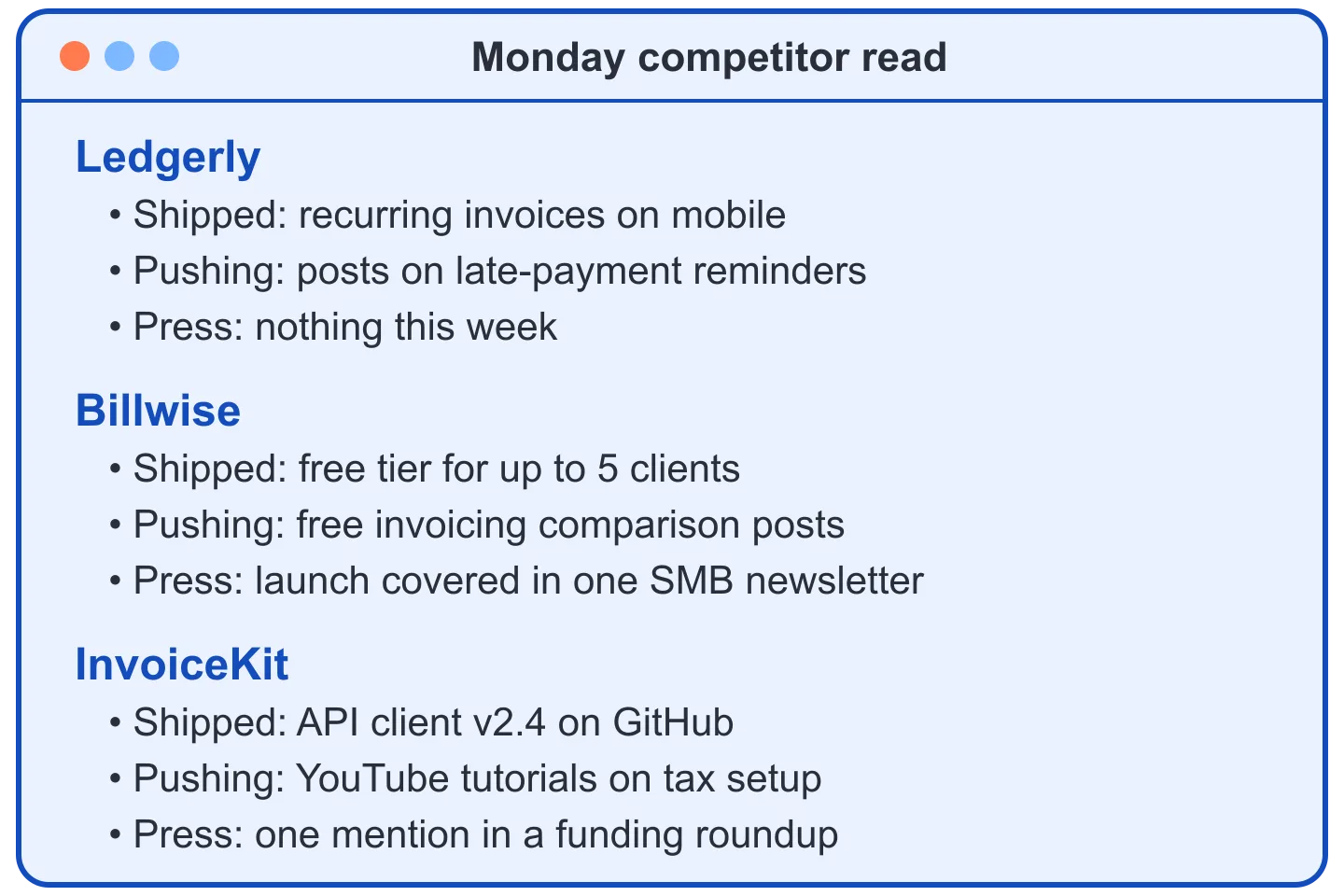
Filter by one rival tag, skim the week, and write three lines: what they shipped, what they're pushing in content, and what the press said. Then do the next rival. For Tallybook, a week might look like this:
Ledgerly
- Shipped: recurring invoices on mobile
- Pushing: posts on late-payment reminders
- Press: nothing this week
Billwise
- Shipped: free tier for up to 5 clients
- Pushing: free invoicing comparison posts
- Press: launch covered in one SMB newsletter
InvoiceKit
- Shipped: API client v2.4 on GitHub
- Pushing: YouTube tutorials on tax setup
- Press: one mention in a funding roundup
Post it where sales and product will see it. The Billwise line alone is worth the half hour.
AI can draft the note for you. Crayon found 60% of compete teams use AI daily, and summarizing content is one of the top uses. Paste the week's items in, then check every line against its source before you share it.
Which news monitoring tools do you need?
For a team of one, the free set usually covers it. Paid suites earn their price when someone has to report on coverage.
| Tool | Cost | Covers |
|---|---|---|
| Google Alerts | Free | Web mentions, RSS |
| Google News feed | Free | News search results |
| changedetection.io | From $8.99/mo hosted | Page changes |
| Paid suites | Paid | Sentiment, reports |
The paid suites are tools like Meltwater, Talkwalker, Mention and Brand24. They add features such as sentiment analysis and reporting, and Meltwater also covers broadcast and print. Google Alerts has no sentiment analysis.
Pick a paid suite if leadership wants regular coverage reports, or you need TV, radio or print. If the goal is hearing about Billwise's free tier before a prospect tells you, free feeds plus a page-change monitor do that.
Is RSS still good for competitor monitoring?
For this job, yes. WordPress still ships feeds by default. YouTube channels and GitHub releases have their own. Google Alerts and Google News searches both output RSS.
Social networks are the weak spot. YouTube has a native feed. For the others, check whether a feed builder supports them, or fall back on the platform's own notifications.
Why did a competitor feed go quiet?
After a redesign the feed URL can move, or the old feed keeps loading but stops getting new posts. Often there is no error at all.
If Ledgerly's feed hasn't moved in three weeks, compare its newest item with the newest post on the site. If they differ, try the blog paths again.
An empty YouTube feed can mean you used the @handle. Swap in the ID that starts with "UC".
A GitHub feed with no entries can mean the team tags versions without publishing releases. Open the repo's releases page once to check.
A quiet Google Alert can mean the sources or "How many" settings are too narrow. Widen them and see what comes back. Too much noise is the opposite fix: add the product category to the query, or split one broad alert into two.
📌 Once a month, open each feed and check the date of its newest item. A feed that's three weeks behind its site is the one that will cost you a sales call.
Running the Monday read in Feedigy
Feedigy's Content Feeds page can be the reader. Paste up to 100 feed URLs at once, upload an OPML file or connect NewsBlur, and duplicates are skipped. Filter by the "Billwise" tag, click Preview, and every Billwise feed shows in one timeline. Full article loads the whole post when a feed only has a summary.
For sources without a feed, smart feeds build one. A News feed per rival name uses Google News, needs no key, and takes include and exclude keywords. YouTube feeds work by channel with your free Google API key. A Reddit Domain feed shows posts linking to a rival's site, and X feeds follow an account or keyword. Smart feeds refresh when you read them, at most every 30 minutes for Reddit, every hour for News and every 4 hours for YouTube and X.
Keep changedetection.io on the pricing pages. Feedigy doesn't watch pages for changes.
Create your Feedigy account and import your rival feeds to start competitor monitoring from one page.