
























Say you run social for a coffee roaster with two locations. Four feeds post on a schedule to Instagram, Facebook, LinkedIn and a weekly email digest. One morning the industry news feed shares a story about a labor dispute at a farm you buy from. It goes out under your usual cheery caption, with the news site's logo as the photo.
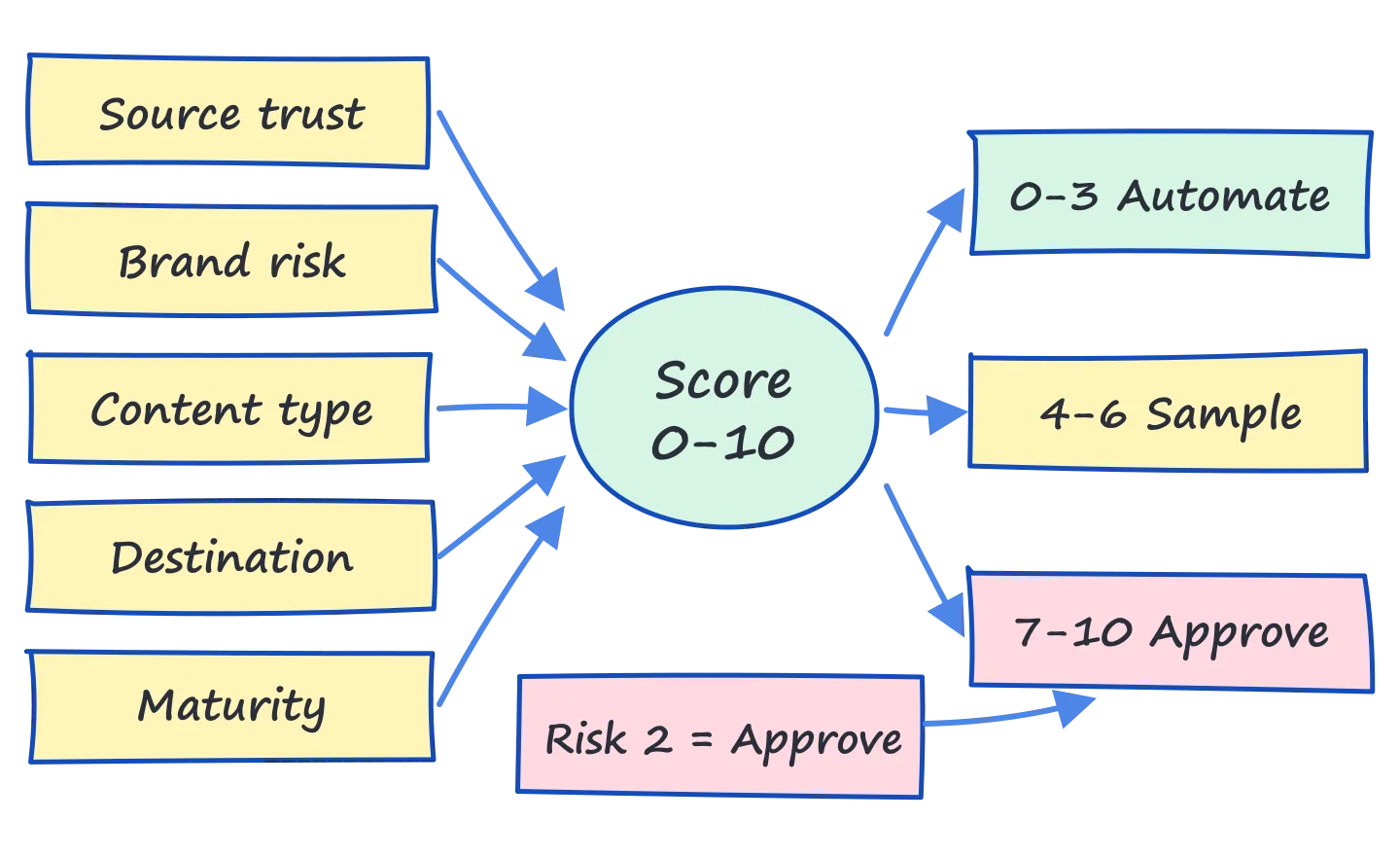
Human in the loop AI for social media automation comes down to one rule. Automate the posts where a mistake is cheap and you trust the source, and put a person in front of the rest. To tell which is which, score each feed on five factors: source trust, brand risk, content type, destination and campaign maturity.
This post covers human in the loop AI for publishing, where the human is the person who checks posts, before or after they go live. The machine learning meaning (people labeling training data) gets a short section near the end.
Why do "review everything" and "automate everything" both fail?
Reviewing every post sounds safe. In practice the queue backs up and the reviewer starts skimming. After a few weeks the reviewer clicks approve without reading.
Automating everything fails faster. Zoho Social points to Joan Rivers' Facebook page, which kept posting smartphone promotions "just days after her demise." Zoho calls it "a classic case of social media scheduler gone berserk." Postly makes the general point: automation "lacks the situational awareness to pause itself."
Readers notice too. In Sprout Social's Q1 2026 Pulse Survey, 56% of respondents said they see AI slop on social media often or very often. The survey defines slop as mass-produced, often low-quality content made at scale to chase views and engagement. A feed that posts whatever arrives is how a small brand ends up in that pile.
Planoly's rule is a fair middle ground: "Automate the operations. Keep the voice." The five factors below show where operations end and voice begins for each feed.
Which five factors set review for social media automation?
Score each factor 0, 1 or 2, where a low score means safe to automate. Score each feed and channel pair, since the same feed can be fine on Facebook and risky in an email.
Source trust
Who controls what comes down the feed? The roaster's own blog scores 0, because the team wrote every post. The green coffee importer's news feed scores 1: it's a partner they know. The industry news site scores 2, since nobody at the roaster decides what it publishes.
Feeds from sites you don't control break in dull, predictable ways, and Postly lists the usual ones. RSS feeds "often pull the wrong image," like the site logo instead of the featured photo. Ghost posts link to a paywall or a "Coming Soon" page. Some WordPress-style feeds republish old articles with new timestamps, so one article can post several times if your tool doesn't catch repeats. In Postly's words, "a bot will happily share a broken experience with your entire audience."
Brand risk
What does a bad post cost? If a blog repost has a clumsy caption, a few people scroll past. If the roaster seems to cheer a story about a farm dispute, wholesale buyers notice.
Audiences punish content that feels mass-produced, and an AI-rewritten caption on an automated feed can land there fast. Sprout Social found that half of Gen Z will block or unfollow accounts that post AI slop, and six in 10 consumers say they're less likely to engage with brand content "in this AI atmosphere." Score 0 when a mistake is harmless, 1 when a wrong price or date would hurt, and 2 when a post could offend or mislead.
Content type
Evergreen posts age well. The roaster's brewing guides score 0 and read the same in March or November. Event listings score 1 because they carry dates, and the Saturday market can get rained out after the feed has already picked it up. News, opinions and anything about real people score 2.
Destination
Where a post lands changes what a mistake costs. A Facebook post can come down within a minute, so it scores 0. LinkedIn, where café owners and wholesale buyers follow the roaster, scores 1 because tone matters more there. Instagram scores 1 too: every post needs an image, and a wrong image is the first thing people see.
The email digest scores 2. Once it's sent, it sits in every subscriber's inbox and you can't pull it back.
Campaign maturity
How long has this feed, template and channel run clean? Three months or more without a correction scores 0, so the blog-to-Facebook setup, which has posted since spring, gets a 0. Two weeks or more earns a 1. Anything newer, or anything you just changed, scores 2, like the events feed that went live last week.
Maturity is the one factor that moves over time.
How do you score a feed for human in the loop AI review?
Add up the five scores. The total, out of 10, picks the tier.
| Factor | 0 points | 1 point | 2 points |
|---|---|---|---|
| Source trust | Your own site | Known partner | Site you don't control |
| Brand risk | Harmless if wrong | Wrong price hurts | Could offend |
| Content type | Evergreen | Dated, like events | News, people |
| Destination | Easy to delete | Pro or image-led | Can't unsend |
| Maturity | 3+ months clean | 2+ weeks clean | New or just changed |
- 0 to 3: Automate
- 4 to 6: Sample
- 7 to 10: Approve
One override applies: a 2 on brand risk means Approve, whatever the total. A tidy setup doesn't make a risky post any safer.
Here's the roaster's setup, scored on paper:
| Feed to channel | Source | Risk | Type | Dest. | Maturity | Total | Tier |
|---|---|---|---|---|---|---|---|
| Blog to Facebook | 0 | 0 | 0 | 0 | 0 | 0 | Automate |
| Blog to email | 0 | 0 | 0 | 2 | 0 | 2 | Automate |
| Events to Instagram | 1 | 0 | 1 | 1 | 2 | 5 | Sample |
| Importer to LinkedIn | 1 | 1 | 1 | 1 | 1 | 5 | Sample |
| News to Facebook | 2 | 2 | 2 | 0 | 1 | 7 | Approve |
Look at the email digest. It scores 2 on destination alone, but because the feed is the roaster's own mature blog, it stays in Automate.
What does each tier look like day to day?
Automate
Posts go out on schedule with nobody checking them first. Once a week someone scrolls through what went out and checks images, links and repeats. For the roaster, that covers the blog feed to Facebook and to the digest. If these posts read stiff, our guide to making RSS auto-posts read less robotic has fixes.
Sample
Posts still publish on their own, and a person reads a set share of them soon after they go out. Here's a rule simple enough to keep on paper: about one in five posts, read the same day. The events and importer feeds live here.
One rule applies to every tier: read the first ten posts from any new feed or template, whatever it scored.
Approve
Each post waits as a draft until a person reads it and then sends or schedules it. Twin.so's tiers for AI agents put anything public at one-click approval by default. In this scorecard, only feeds that score 7 or more, or 2 on brand risk, get that treatment, like the industry news site. For what the reviewer should check in each draft, see our guide to reviewing AI drafts.
What should you never automate on social media?
Some posts belong to a person, whatever they score:
- ❌ Replies and DMs. Planoly says it plainly: "A comment thread is a relationship, not a queue item."
- Crisis statements, and anything you post while a crisis is going on.
- Apologies and corrections.
- Legal or compliance wording. Twin.so keeps a human-authored tier for work with legal or compliance stakes.
You can still schedule these once a person has written them. Planoly notes that scheduling applies "once you've already decided what it says."
How do you know when a feed is safe to automate?
Move a feed up one tier only once it has a clean record. Twin.so lists four conditions before giving an AI agent more autonomy: a track record, stable channel rules, a low cost of mistakes, and a rollback or kill switch. The same conditions work for feeds, and the score does the bookkeeping. After three clean months, the events feed's maturity drops to 0 and its total to 3, so it moves to Automate, as long as someone can pause it in one click. The importer feed bottoms out at 4, so it stays in Sample. Not every feed graduates, and that's fine.
Promote one feed and channel at a time. Twin.so's version: "Graduate channel by channel, action by action, never by flipping a global switch."
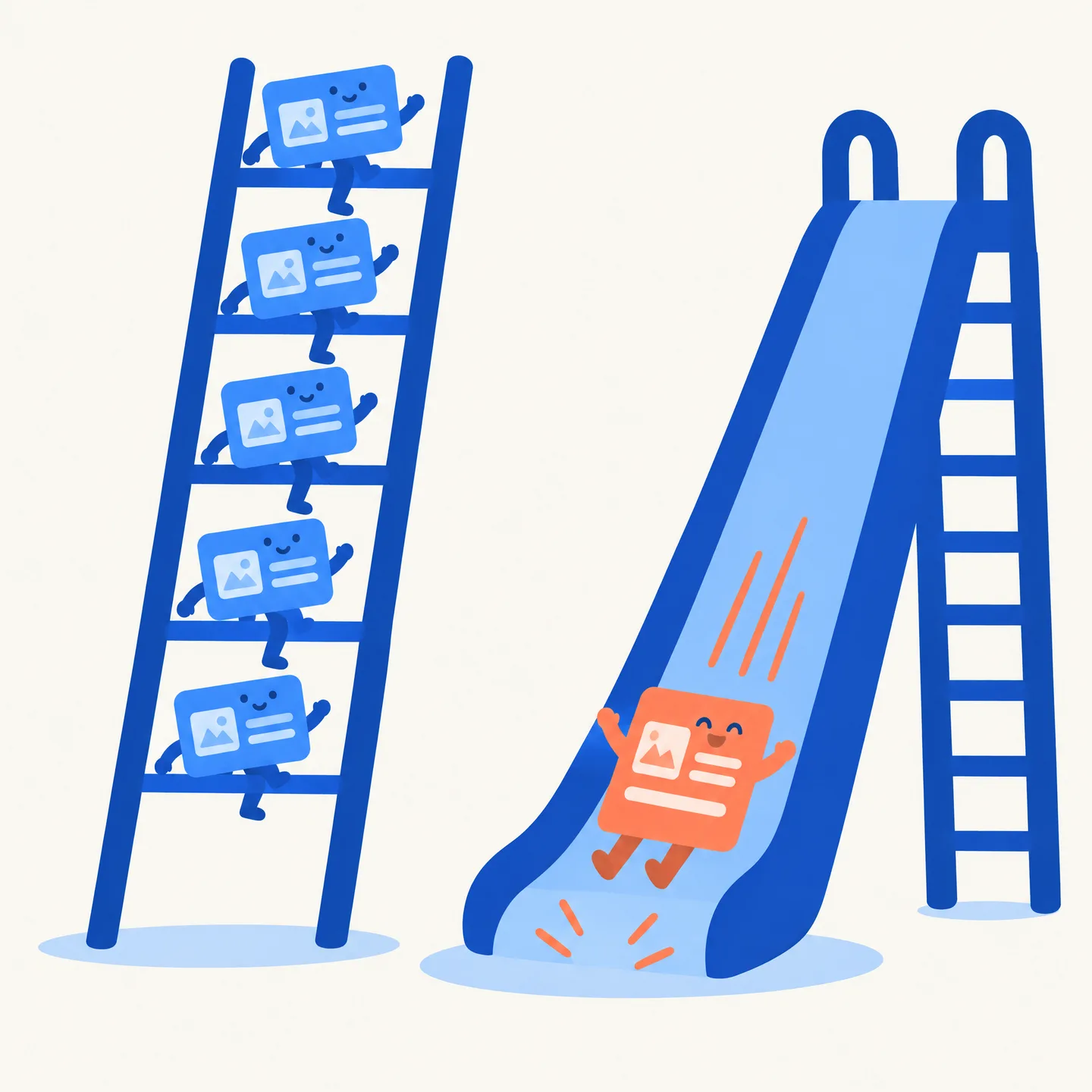
Demote faster than you promote. Drop a feed a tier, or pause it, when:
- ⚠️ News breaks that touches your brand, your suppliers or your town. Zoho Social's answer is to pause the queue, which holds queued posts while you can still post live by hand.
- You rebrand. Zoho warns that a scheduler can publish a post with "your old logo and theme."
- You change the template, the AI prompt or the feed itself. Maturity goes back to 2.
- A post needed a correction. Maturity goes back to 2, so re-score the feed. The brand-risk override still applies.
What does human in the loop AI mean in machine learning?
In machine learning, the human works inside the model's own process. IEEE describes it as the involvement of "human annotators or reviewers in the training, evaluation, or active operation of a model," as opposed to fully automated pipelines where the system acts without human review. Labeling training data is the classic example. IEEE also separates human on the loop, where a person monitors an automated system and steps in only on exceptions. In this scorecard, the Approve tier keeps a person in the loop before a post goes live. Automate and Sample keep one on the loop.
How can you run review tiers in Feedigy?
Auto-Publishers cover the Automate and Sample tiers. Each one takes posts from up to 10 feeds and publishes them to one channel on a schedule, and its settings apply to every feed in it. Give each feed and channel pair that needs its own rules its own Auto-Publisher. In Advanced mode, Exclude keywords skips posts that contain words you'd rather not automate. Only new items ignores older posts, and each Auto-Publisher remembers what it posted, so nothing goes out twice. Check the live preview, send one real post with Test Post, or choose Save & Pause to set it up without publishing. When news breaks, tick several Auto-Publishers in the list and pause them together. Read how Auto-Publishers work.
Keep Approve-tier items out of automation. Post to channels on a feed item opens the composer with its title, excerpt, link and images already filled in, so a person checks the post and sends it. You can also tick As draft in Schedule post to park it on the Publishing Calendar with a Draft badge until someone reviews it. Feedigy has no multi-person approval step, so whoever reads the draft is your human in the loop AI check. Create a Feedigy account and set up your first Auto-Publisher.